Dreamy environments
Pastel skies, cotton-cloud hills, arched doorways, staircases that lead somewhere you can’t quite see yet. Soft materials — matte, fuzzy, iridescent, never chrome. This is where discovery and calm live.
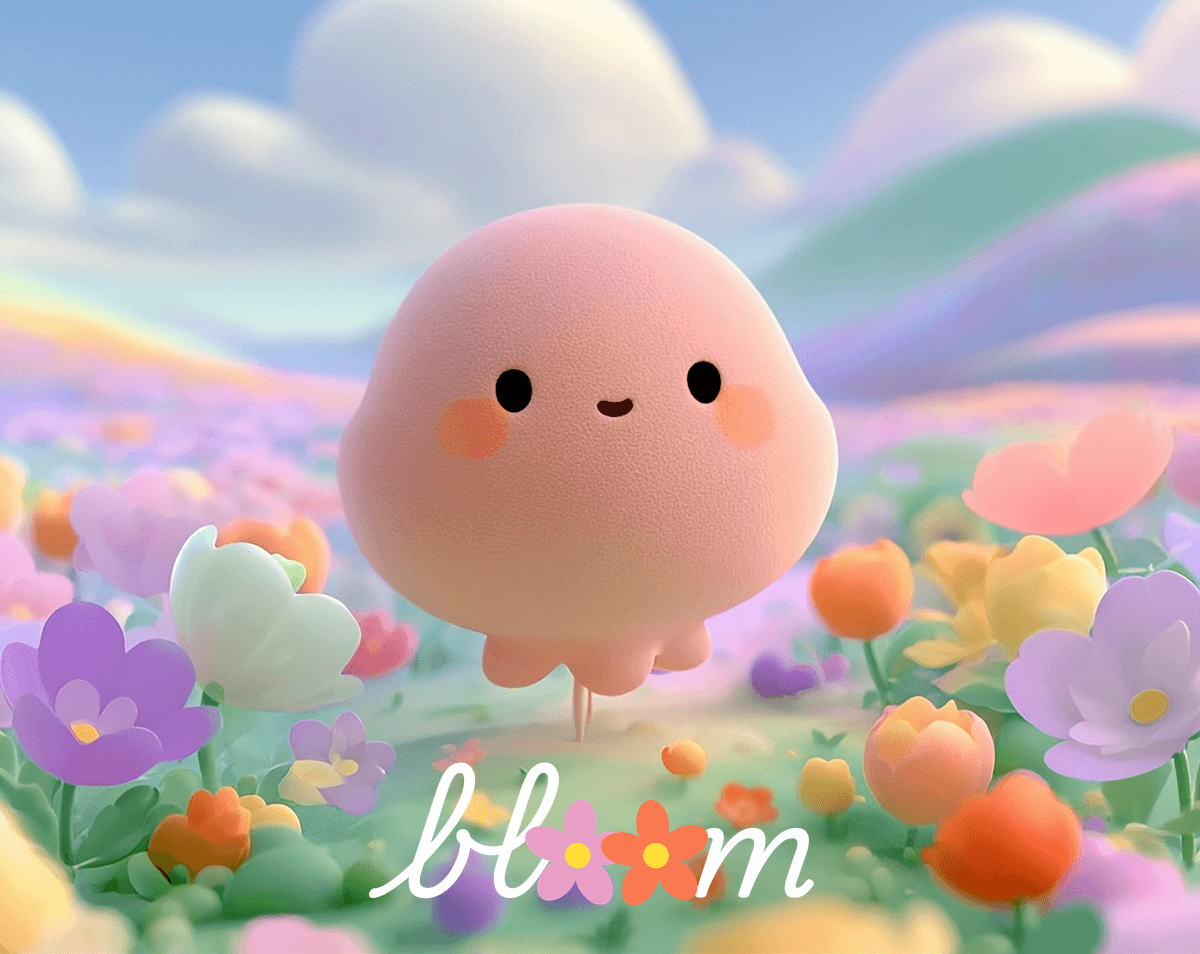
the Pip, out in the valley — the game’s cover
A valley, waking up
“A place for creative play and discovery. Somewhere you wander into.”
Bloom is a calm puzzle game about waking a drought-struck valley back up, one small tending at a time. You play as a Pip — a seed that decided to have a face. It’s free, it runs in your browser, and this is the whole of it: how it plays, how it looks and talks, and what it hides.
the world
Everything in Bloom is built from two visual strands working together — neither one takes over. A single screen might put a doodly character inside a cathedral-sized pastel arch, and that contrast is the whole look.
Pastel skies, cotton-cloud hills, arched doorways, staircases that lead somewhere you can’t quite see yet. Soft materials — matte, fuzzy, iridescent, never chrome. This is where discovery and calm live.
Hand-drawn creatures with faces on shapes. Dot eyes, a one-line mouth, expression carried by posture. Crayon-and-gouache energy — a character is just a shape that decided to have a face. This is where curiosity and fun live.
A wobbly character wearing the world’s materials — dot eyes and a one-line mouth on a soft, fuzzy body.
from the game — Reach One, level one
This is First Thaw — the real opening mechanic, taped straight into the page. Solve it and this corner wakes up the way the whole valley does.
0 of 5 placed
Drag the petals around the ring until every slot settles — or tab to a petal and use the arrow keys, then Enter. Nothing is timed and nothing can go wrong.
design principles
If a design decision serves none of these, it gets cut.
Nothing is precious. Wobbly lines beat perfect ones.
There's always another door. Reward wandering.
Make it yours. Your Pip, your pace, nothing is scored.
Ask more than you answer. Invite “what happens if I…”
Space, air, quiet. Even loud colors have soft edges.
the eight Reaches
Bloom is built in Reaches — chapters of the world, each with one idea it trusts completely, played with a drag or a tap. Eight so far, and the world keeps going.
Each region hides a flower. Drag petals around the ring until every slot settles and it comes together.
Drag the buds until no bramble crosses another. Tense strands show terracotta; a clear one relaxes back to green.
Fit the fallen stones back into each bed — no gaps, nothing over the edge. Tap a stone to turn it.
Turn the channels a quarter at a time until water runs unbroken from the spring to every root, with nothing spilling into dead ground.
Turn the leaves over two at a time and bring every creature back together with its pair. A mismatch simply turns back.
The counts along each row and column say how the stars sit. Fill them in, line by line, until the night shows its picture.
Plant so every row and every column has one of each seedling, no plot doubled. Any planting that follows the rule takes.
The letters are all still here, just out of order. Put each name back together, three to a level, and watch what answers to it.
Every bloom moves the valley one region — and one hour — forward. Eight skies, dawn to glowing night, straight from the game’s region palettes. Watch the day roll by, or pick an hour:
First Thaw · region 1 of 8
“And when the dark comes, the valley is not afraid of it. It glows.”
no pressure, by design
…and the Hollow keeps a few things hidden for the curious.
hidden things & dew
Seven things are tucked into the Hollow — a glinting stone, a shy critter, a wandered-off cloud, a buried seed, a beetle, an early star, a coaxed-up spring. Unfound, each is the faintest shimmer. Found, it pops into a little gold star, pays six dew, and writes one line like a field journal:
“A small cloud that had wandered off. You waved it home.”
They’re never signposted — generous to find, hard to notice. Levels pay twelve dew, hidden things six, and it all spends on exactly one thing: the Pip’s wardrobe, below.
(this page hides a few of its own, by the way)
✦ 0 of 3 found on this page
from the game — growing a Pip
The Pip grows a stage with every bloom — color, a sprig, a stem, a bud, then a flower of its own. Dew buys only personality: accessories never change how the game plays, and nothing is locked behind them.
All eight from the game, with their real prices in dew (◍). Toggle anything on and off — nothing to save up for here.
color
The game’s palette comes in two layers. The sky layer is calm and covers most of every screen; the character layer is loud, small and joyful — a petal, a critter, a button, never a whole surface.
Cloud White
#F7F5F2
app background, cards
Pale Sky
#D1E4E2
section backgrounds
Blush
#E9CBE3
warm surfaces, resting
Periwinkle
#99A9E4
illustrated tints, hovers
Dusk Blue
#5E7DC5
primary UI, links, focus
Deep Ink
#2E2A24
body text, line art
Bloom Pink
#E99DC5
Coral
#FB7752
Sunshine
#EB981C
Mustard
#DFC235
Mint
#7DB699
Cobalt
#385F9C
Grape
#8F5391
typography
The logo’s looped script is logo art, not a typeface — it sets the name and nothing else. Everything else is these three:
Lora · roman 400–600
Wake the world back up.
Lora · italic — the voice
The Hollow is green again.
Inter · body, 16/24
A warm humanist sans for reading and UI. Sentence case for everything — Bloom doesn’t shout.
Edu SA Hand · accents
a little note to self
the blooms are the o’s — one pink, one coral, centers always #FFDE37. The logo is never re-typeset.
voice & tone
Warm, concrete, unhurried, honest. No motivational-poster language, no fake enthusiasm, and if a message needs an emoji to feel warm, the message gets rewritten. Pick a situation:
Instead of “Welcome back! Ready to create? 🎨” —
making it
These games were how I learned game design, one mechanic at a time. What this one taught me:
Bloom grew into eight Reaches, each with its own puzzle: aligning petals, untangling brambles, packing stones, routing water, matching pairs, nonograms, planting a Latin square, and anagrams. Each one was a small study in a different kind of thinking.
The puzzles are generated, so each generator builds backward from a solution: packing beds are carved from a real tiling, water routes come from a spanning tree, and the bramble generator was checked across 3,200 random boards. Every Reach also got a “Stuck?” hint and a first-time how-to.
At first the Pip reached full bloom by the end of the first valley, and then there was nothing left to grow toward. Now its growth is spread across the whole journey, and full bloom waits for the very last level.
The first creatures were clean vector shapes and read as clip art. Redrawn with flat fills and a wobbly ink outline, they started to feel like characters.
under the hood
The valley is free, it runs in your browser, and it will wait for you as long as you need.
Play Bloom in your browser